
DORNIKA
Producing Sustainable green nano material production
Nanomaterials extraction from industrial effluents, production of industrial chemicals in micron and nano scales

Product Category
About Us
DorniKa Sabz Knowledge Base Company was established in Mashhad in 2023 by experts in nanotechnology, chemistry, and materials science, with the goal of producing chemicals through environmentally friendly methods leveraging nanoscience. In 2023, the company joined the Science and Technology Park at Ferdowsi University of Mashhad. The company’s primary activities focus on recovering valuable materials from waste and industrial effluents to mitigate their harmful environmental impacts. Currently, Dornika Sabz is concentrating on recycling materials from industrial wastes, including those from electroplating, steelmaking, and leather industries. One of their most successful projects is the production of green chromium oxide nanoparticles from chrome plating waste, developed using an innovative and cost-effective method. This project was recognized as one of the top 25 national projects out of 2500 at the 13th edition of Iran’s International Innovation and Technology Exhibition “Inotex”.

How harmful is industrial waste?
When dumped into waterways, lakes or oceans or landfills, hazardous materials can release toxins into the environment, disrupting habitats and causing harm to wildlife and humans. Damage to watersheds, air pollution, and contamination of soil are only a few of the dangers of improper industrial waste management. Several waterborne pathogens proliferate in wastewater and produce toxins, affecting the earth's ecosystem and human health. The toxins in industrial wastewater cause acute poisoning, immune system suppression and reproductive failure.
According to the WHO, around 80% of diseases are waterborne. To address the environmental and health issues created by industrial wastewater, it is absolutely necessary to obliterate its toxicity by adequate treatment with physical, chemical and biological means so that it can be recycled for water conservation.
Nanomaterials
The meaning of the word ‘nano’ is nanos, which indicates a person of very low height or a very small object that is a dwarf. Consider that in an international system of units, the prefix nano is used to indicate part of a unit. For instance, a nanometer is a billionth of a meter or a millionth of a millimeter; a nano liter is a billionth of a liter or a millionth of a milliliter; and a nano is a billionth of a Kelvin. The prefix “nano” has found in the last decade an ever-increasing application to different fields of knowledge and is now a popular label for much of modern science; therefore, it is becoming increasingly common in the scientific literature. Size, which refers to the length scale from 1 to 100 nm, is the fundamental defining attribute of all nanoparticles, in which materials have at least a nanoscale dimension. Thus, according to refs. nano-materials are substances that are between 1 and 100 nm in size, at least in one of the three dimensions and must be greater than 60 𝑚 2/𝑐𝑚 3 in terms of spherical surface area by volume.
Based on size, origin, structural configuration, pore diameters, and potential toxicity, nanomaterials can be divided into five major categories. Due to its unique properties, nanoparticle matter exhibits unique chemical, physical, and biological properties at the nanoscale compared to their respective particles at higher scales. Nano particulate matter is a distinct state of matter from the solid state, liquid state, gaseous state, and plasma state. In this dimension, their nanomaterials have distinctive optical, magnetic, and electrical properties. There are other ways to make nanomaterials, but the two basic approaches are bottom-up and top-down methods. Examples of top-down techniques include lithography, mechanical milling or ball milling, laser ablation, sputtering, electron explosion arc discharge, and thermal decomposition. Examples of bottom-up techniques include chemical vapor deposition (CVD), sol-gel, spinning, pyrolysis, and biological synthesis. The field of study known as nanoscience is concerned with the characteristics of matter at the nanoscale, with a focus on the special, size-dependent characteristics of solid-state materials. The field of study known as nanotechnology includes the synthesis, engineering, and application of nanomaterials. Due to the innovative and intriguing applications of nanomaterials for the next industrial generation, nanotechnology has attracted a lot of interest over time. Agriculture, biomedicine, electronics, energy, pollution abatement, food engineering, transportation, telecommunication, cosmetics, coatings, materials, and mechanical engineering are just a few of the industries that use nanomaterials. Nanomaterials are now becoming important for the overall development of mankind. For example, to reduce the risk of global climate change and global warming in the first place, the only solution is to use green technology that works only using nanomaterials. Because it has been confirmed that the technology that uses nano-materials is more effective than the technology that uses bulk materials. Secondly, nanomaterials are used to develop tools to diagnose and control the epidemic dis-eases that are happening all over the world. For example, in 2019, Covid-19, a disease that was killing many people in the world, was able to be diagnosed and controlled using nanomaterials. Also, it was possible to diagnose and treat the monkey pox disease that is currently happening in the world by using nanomaterials. In the future, it is expected that nano materials, nano science and nano technology will play a leading role in the development of the world.
How do nanomaterials be classified according to the number of dimensions?
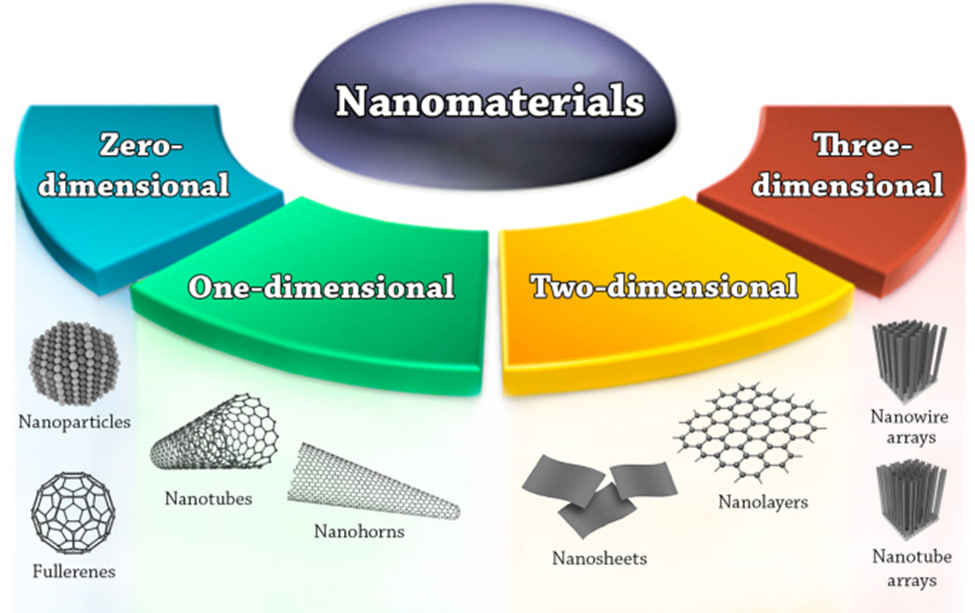
Nanomaterials are classified into four types based on their size dimensions: 0D, 1D, 2D, and 3D, as shown in Figure.
Zero-dimensional nanomaterials
These nanomaterials have all three dimensions (x, y, and z) within the nanoscale range or are not dimensional outside the Nano metric range (>10 nm). QDs, fullerenes, and nanoparticles are examples of 0Dnanomaterials. They can be amorphous or crystalline, single crystalline or polycrystalline, exhibit various shapes and forms, and be metallic or ceramic.
One-dimensional nanomaterials
Nanomaterials in this class have two of their three dimensions (x, y) in the nanoscale range, but one dimension of the nanostructure is outside the non-metric range (>10 nm). 1D nanomaterials, such as nanofibers, nanotubes, nano horns, nano rods, thin films, and nanowires, are examples of needle-shaped nanomaterials. They can be amorphous or crystalline, single crystalline or polycrystalline, chemically pure or impure, standalone materials, or embedded within another medium, such as metallic, ceramic, or polymeric. 1D nanoparticles can be metallic, ceramic, or polymeric.
Two-dimensional nanomaterials2D
nanomaterials have plate-like shapes with two dimensions outside the nanometer range, but 1D (x) is at the nanoscale (between 1 and 100 nm). Coatings and thin-film multilayers, Nano sheets or nano walls, free particles, tubes, fibers, ultrafine-grained over layers, wires, and platelets are examples of 2D nanomaterials. 2D nanomaterials can be amorphous or crystalline, made of various chemical compositions, deposited on a substrate, or integrated into a surrounding matrix material, metallic, or polymeric.
Three-dimensional nanomaterials3D
nanomaterials or bulk materials are nanomaterials that are not confined to the nanoscale in any dimension or dimension range. All dimensions of a 3D material are out-side the nanometer range or greater than 100 nm, but the bulk material is made up of individual blocks that are in the nanometer scale (1–100 nm), so 3D nanomaterials have three arbitrary dimensions above 100 nm. It includes nanoparticle dispersion, bundles of nanowires and nano tubes, and multi-nano layers in which the 0D, 1D, and2D structural elements are in close contact and form inter-faces. Thin films with atomic-scale porosity, colloids, and free nanoparticles with various morphologies are examples of 3D nanomaterials.
WHAT ARE THE PROPERTIES OF NANOMATERIALS?
The properties of nanometer-scale materials differ significantly from those of atoms and bulk materials due to surface charge/interaction, crystallography, composition, surface area, and nanoscale size effects, which can be seen in the magnetic, optical, electrical, mechanical, chemical, and physical properties of nanomaterials. The purity and performance of the nanoparticle are determined by its chemical or elemental composition. Particle size is one of the most fundamental and important measurements for nanoparticle characterization. Electron microscopy is the most commonly used technique to measure the size and distribution. The sur-face area-to-volume ratio of a nanoparticle has a significant impact on its performance and properties. The surface area is most commonly measured using Brunauer–Emmett–Teller (BET) analysis. The purity and performance of nanoparticles are directly related to their chemical or elemental composition. A nanoparticle’s interactions with a target are deter-mined by either its surface charge or its overall charge. One of the most common applications for a zeta potentiometer is to measure the surface charges and dispersion stability of a substance in a solution. Nanomaterials: The scientific study of the arrangement of atoms and molecules within crystals and other materials is known as crystallography. Crystallography can be used to determine the structural organization of nanoparticles using powder x-ray diffraction, electron diffraction, or neutron diffraction. Nanomaterials Concentration is needed to quantify the number of nanomaterials dispersed throughout the gaseous phase in order to calculate the concentration of air or gas required for the operation.
Physical properties of nanomaterials
The melting temperature of a bulk material is not dependent on its size, but the melting point of nanomaterials decreases as the particle size decreases due to the unbounded surface atoms. The total volume of a bulk material remains unchanged when it is subdivided into nanoscale materials, but the collective surface area increases. In comparison to bulk materials, this results in an increase in the surface-to-volume ratio at the nanoscale. The surface molecules or atoms have a high surface energy and a proclivity to agglomerate. The colors of gold and silver nanomaterials are size-dependent, as are their effects on the coloring of stained glass.
Magnetic properties of nanomaterials
The magnetic behavior of elements can change at the nanoscale because of the size of magnetic nanoparticles. The nano structuring of bulk magnetic materials alters the curves, resulting in soft or hard magnets with improved properties at the nanoscale. The size has the ability to increase coactivity and super-paramagnetic behavior at critical grain sizes. Nonmagnetic bulk materials can become magnetic at the nanoscale. For example, gold and platinum are non-magnetic in bulk but magnetic on the nanoscale. Magnetic nanomaterials are used in biomedical applications such as drug delivery magnetic resonance imaging (MRI) and magnetic fluid hyperthermia.
Optical properties of nanomaterials
Localized surface plasmon resonance (LSPR) is an optical property of nanoparticles. Some studies have shown that the line width is influenced by the size of nanoparticles. For example, by decreasing the size of Au nanoparticles, the emission light position changes from the Near-infrared(NIR) region to the ultraviolet (UV) region. Due to their very small size, nanoparticles can lose their LSPR and become photoluminescent. As a result of quantum confinement in nanomaterials, visible light emission can be tuned by varying the nanoscale dimensions. It has been discovered that as the size of the nanomaterials decreases, the peak emission shifts toward shorter wavelengths. Matter can change color at the nanoscale; for example, gold nanospheres can turn to yellow at 100 nm, greenish yellow at 50 nm, and red at 25 nm, while silver can also turn orange at 200 nm, light blue at 90 nm, and blue at 40 nm spherical thin film length.
Electrical properties of nanomaterials
Nanomaterials can increase conductivity in ceramics, but increase electric resistance in metal. Electron conduction is delocalized in bulk materials, which means electron scan move freely in all directions. When the scale is reduced to the nanoscale, the quantum effect takes over; electron delocalization occurs along the axis of nanotubes, nanorods, and nanowires. Due to electron confinement, the energy bands are replaced by discrete energy states, causing conducting materials to behave as either semiconductors or insulators. This result indicates that the metal is becoming a semi-conductor. Carbon nanotubes, for example, can be either conductors or semiconductors depending on their nanostructure. To reduce the diameter of the wire, the number of electron wave modes contributing to electrical conductivity is reduced in well-defined quantized steps.
Chemical properties of nanomaterials
The applications of this substance are determined by its chemical properties, which include the reactivity of the nanoparticles with the target and their stability and sensitivity to elements such as moisture, environment, heat, and light. The flammability, corrosiveness, anti-corrosiveness, oxidative potential, and reduction potential of the nanoparticles all play a role in determining their applications. Nanomaterials have significantly improved or novel catalytic properties such as reactivity, selectivity, and catalysts compared to their bulk analogues.
Mechanical properties
Materials’ mechanical properties of the materials, such as elasticity, ductility, tensile strength, and flexibility, play an important role in their application. Influence on mechanical properties in nanomaterials, such as increased hardness, yield strength, elastic modulus, and toughness compared to bulk materials. Strength and hardness of nano structured materials increase with decreasing grainsize and grain boundary deformation. The increase in mechanical strength is simply due to a lower probability of defects and an increase in imperfection. It improved alloy hardness and toughness as well as ceramic super plasticity.
Frequently Asked Questions
Most of the nano-materials synthesized in Dornika Sabz company are obtained from industrial wastes by bottom-up method, which have the following advantages:
- Introducing cutting-edge nanotechnology in service of the green environment and producing a high-tech, high-value production by removing potentially harmful effluent.
- Unlike other costly disposal or purification systems for industrial effluents, instead, we make use of them
- Our product has significant export potential and offers opportunities to sell the technology across various industries.
- Reduce the country's reliance on imports by producing industrial necessary materials from effluents Our production process achieves over 30% net cost reduction
It will take from three days to thirty days depending on the amount of your order and your location.
Yes, you can mention these items in your order and agree with our commercial and sales department.
Yes, a tracking number is assigned for each order, and you can use this tracking number to get the status of your order.
We have no order limits, so you can order from a few grams to several tons.
Low price, high quality and green manufacturing method.
To know the latest prices, you can use our communication methods on this site.